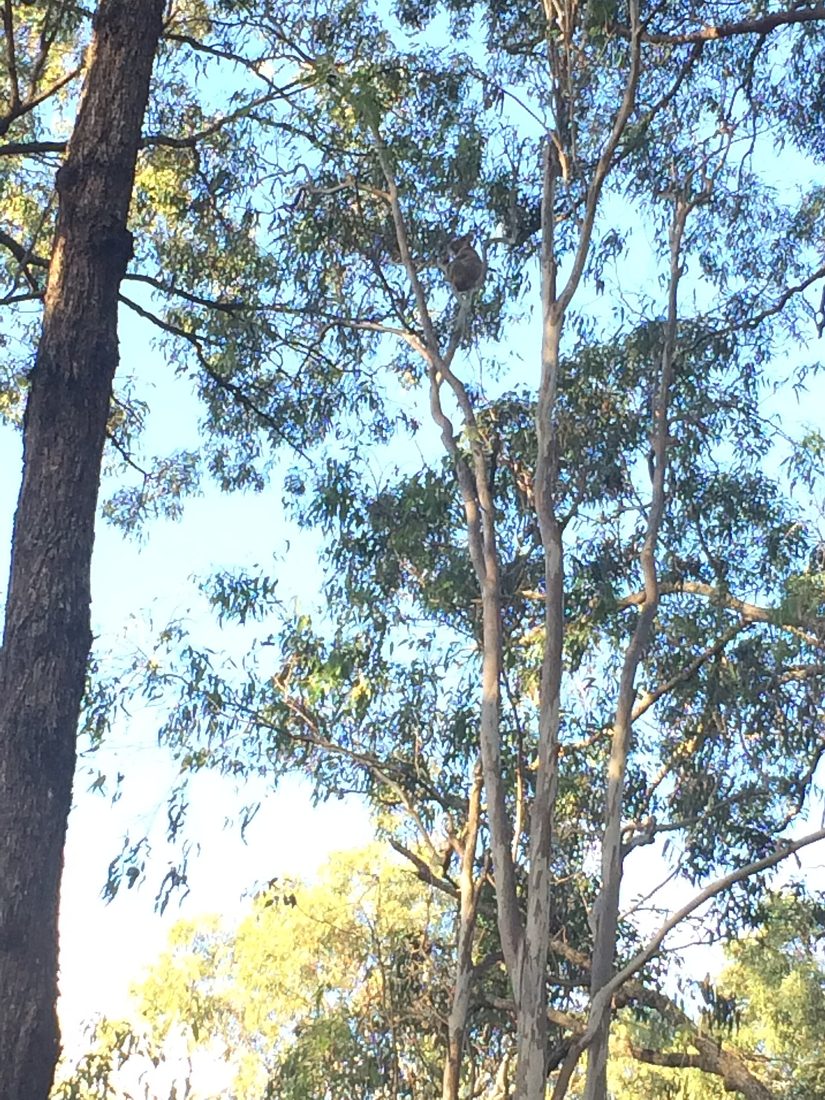
A koala on a suburban power pole is not a heart-warming exception. It is a map. The animal is moving between feed trees that used to be a forest and are now a scatter of backyard gums, a creek line, a reserve the size of a few house blocks, and a road that does not know it is a fence. People take the photograph. The koala is trying to finish a sentence the subdivision interrupted.
South-east Queensland, the New South Wales north coast, Gippsland, pockets of the Adelaide Hills: these are places where the national mascot is also a local traffic problem. Northern populations have been hammered by clearing, cars, dogs and disease. Southern ones sat in cooler forest until fire rewrote the edges. Black Summer made that rewrite visible; the longer ecology sits in bushfire ecology after Black Summer. A green flush on a trunk is not a feed tree restored. This essay is about the unfashionable scale: the backyard, the dog, the night road, and the offset that pretends a certificate is a canopy.
Feed trees, which are not a brand
Koalas are fussy in a way that marketing is not. They eat a short list of eucalypts, and the list changes with region, season and the individual animal's education. Forest red gum, tallowwood, swamp mahogany, grey gum, manna gum, swamp gum: names that mean something on a particular soil and almost nothing on a tag that says "wildlife friendly". A koala in Redlands is not shopping from the same menu as a koala in Strzelecki. Planting the wrong handsome tree is how a well-meaning street gets shade and no food.
Young trees are not a meal. A sapling will not feed anyone this decade. If you have a mature feed tree, the work is to keep it. Lopping for a view or poisoning a stump because the leaves were over the pool is how a corridor becomes a cul-de-sac. Councils that still publish local feed-tree lists are doing the one useful catalogue job. Use them. A corridor is a sequence of trees an animal can walk or climb between. One specimen gum in a sea of buffalo grass is a destination without a road.
Dogs, and the dusk that matters
The koala's predator in a suburb is often a much-loved dog that was let out at the hour the animal is on the ground. Koalas move between trees at dusk and at night. They are not built for a chase. A single bite can be an infection that finishes later, in a carer's laundry, after the owner has said the dog was only playing.
This is not an argument against dogs. It is an argument against unsupervised dogs in streets and yards that are already a koala map. A fence that can hold a dog is a conservation structure. A night routine that keeps the animal in when the koala is likely to be crossing is another. Wildlife-friendly fencing — a gap at the bottom for bandicoots, a clear top that does not snag a climber — is a neighbouring skill, and it belongs in the wider practice of living with urban wildlife without turning the yard into a trap. The koala-specific version is simple enough to sound rude: if koalas use your block, the dog is not on the night shift.
Attacks cluster where habitat has been freshly broken. The year after a clearing is a dangerous year. The household that has just bought into a "bush outlook" estate is often the household whose dog meets a koala first.
Cars, which harvest the night
Roads cut corridors into islands. The koala that leaves a tree at midnight is crossing a space designed for a vehicle doing sixty. A household does not design a highway. It does drive home on a road it knows is a crossing. A speed that matches a known corridor, and a habit of not treating a dusk wildlife sign as décor, are small and they add. If you hit an animal, the next act is not a photograph. It is a call to the local rescue number and a refusal to leave a living animal on a verge. New estates that advertise tree change and then deliver a collector road through a home range are writing next year's rescue statistics in asphalt.
Chlamydia, which is not a moral
Disease is part of the koala story and a poor place for folk wisdom. Chlamydia is widespread in many populations. It blinds, it sterilises, it is treatable in care and not treatable by a householder with a theory. Stress — dog chase, car strike, a heatwave in a thinning canopy, a fire — makes a sick animal sicker. A koala that looks wet-eyed, slow, or oddly present on a low branch in daylight is not a photo opportunity. It is a job for a licensed carer.
This journal will not prescribe. Do not handle the animal or decide it is "just resting". Call WIRES, Wildcare or the local wildlife line and describe the tree and the street. The household contribution is early notice and a dog that is inside. A population can look stable from a tourist boardwalk and still be sliding because the young are not being born.
Offsets, and the tree that is not there
When a development removes koala habitat, the permission often arrives with an offset: hectares secured elsewhere, a payment into a fund, a planting plan on a creek that is not this creek. Sometimes the offset is real, additional, and managed. Often it is a bookkeeping exercise that counts existing bush as if it had been created by the loss, or plants tubes that will not be feed trees until after the displaced animals are gone.
An offset does not walk a koala across a new arterial road. It does not replace the paddock gum that was the stepping stone between two reserves. It cannot be smelled, climbed, or used on the Tuesday after the dozers. Treat the word as a prompt for rude questions. Is the offset already habitat. When will it be a tree of a useful size. Who manages the dogs and the fire and the weeds on that other block. Can a koala on this road reach it. If the answers are a shrug and a map of another bioregion, the offset is a lullaby.
Ask for the existing trees to stay, and for a corridor wider than a single line of tubestock. The certificate will be framed in the clubhouse. The animal will be on the bitumen.
What a backyard can honestly hold
Not every suburb is koala country. Where the animals already move, the honest list is short. Keep the feed trees you have. Plant the right next ones for a later decade. Hold the dog at dusk. Slow down on the road you already know. Call a carer when the daylight behaviour looks wrong. Refuse the story that a logo and an offset have replaced a canopy. A backyard corridor is a sequence of ordinary properties that have decided not to be the break in the sentence. The rest of Wild Neighbours is possums, bees and the species that will not be saved by a gum. The koala is only the animal Australians are willing to see in the street. Seeing it is the start of the work, not the work.